BABY SAFETY INSIDER
The Reason 1 In 4 Babies Hit Their Head Falling Backward — And How To Prevent It As A New Mother
May 14 2026 at 9:17 am EST
"By the time you hear the 'thud,' the impact is already absorbed. Parents think they're fighting clumsiness, or hard floors, or a bad week — they're fighting gravity, and a baby this age is built to lose that fight. It's the most preventable injury I see in my practice every single week, and it has nothing to do with how careful the parent is being." — Dr. Rachel Patel, Pediatric Physical Therapist, 14 years

Hero image goes here — upload it in Content › Files, copy the URL, and paste it into the image src above.
Lila's head bounced off our kitchen tile, and I was four feet away.
If your baby is pulling up to stand on furniture...
If you've replaced your living room with foam mats and edge bumpers...
If you've started avoiding rooms in your own house just to keep her on carpet...
Then what I'm about to share could spare you the worst phone call of your life.
There is one thing working against your baby at this stage that you cannot babyproof, cannot out-react, and cannot love your way around. It doesn't get tired. It doesn't take a day off. It is pulling on your baby's head every second she's upright, in every single room, on every surface in your home.
It's gravity — and a cruising baby's body is almost perfectly engineered to lose to it.
It's affecting nearly 1 in 4 babies between 9 and 14 months. And here's the part that made my stomach drop: the childproofing products you bought to fight it are facing the wrong direction.
What gravity does to a baby this age isn't just the obvious bumps and scrapes that show up immediately. It's the repeated, low-grade head impacts that pediatricians wave off as "just part of learning to walk" — quietly stacking up in your baby's developing brain. Pediatric physical therapists have a name for the gap that lets it happen: the "backward fall blind spot."
The Saturday Afternoon That Broke Me
Three months ago I thought I was doing everything right.
I'm a first-time mom in Phoenix with hardwood floors, a husband I love, and an 11-month-old daughter named Lila.
I'd babyproofed my house twice. Foam mats in the living room. Edge bumpers on every corner. A Boppy pillow propped behind Lila every time she pulled up to stand. I'd done my research.
The first fall happened at 7 AM on a Tuesday. I'd been watching her for an hour. I turned for one second to grab my coffee. I heard the thud before I saw her on the floor.
She didn't cry right away. Those few seconds of silence were the longest of my life.
I called the pediatrician's after-hours line, shaking. The triage nurse actually laughed at me. "Babies fall, mom. They're resilient. Try not to worry." I hung up and stayed up till 3 AM Googling "delayed symptoms in toddlers."
That was the first fall. There would be many more — because the thing that caused it doesn't stop.
Over the next 3 months, I tried to build a wall against gravity, one product at a time. Foam play mats — Lila crawled right off the edge. Edge bumpers — Lila fell backward AWAY from the table. Boppy pillows — she tipped sideways past them every single time. Two different soft beanies — she fell anyway. Twice on the kitchen tile in one afternoon.
I started avoiding rooms in my own house. Then I started avoiding leaving the house entirely.
Then came Saturday. I was loading the dishwasher, four feet from where Lila was cruising along the kitchen island. She let go to reach for something. And she tipped straight backward onto the tile.
I don't remember standing up. I remember sitting on the kitchen floor a minute later, holding her, and finally understanding the thing no bumper had ever fixed: I was right there — four feet away, watching her every move — and it didn't matter. You cannot out-react gravity. No parent can.
And I'd spent three months treating "she didn't get hurt that time" as if it were a safety plan, when really I'd just been getting lucky against something that never stops trying.
That night I posted in my birth-month mom group, desperate. One reply changed everything I thought I knew about why my baby kept falling.
The Shocking Truth About How Babies Actually Fall
The mom in the comments told me to look up something called the protective extension reflex.
Here's what I learned over the next two hours — and what no pediatrician had ever told me.
Babies don't fall the way we do. When an adult trips, we throw our hands out, brace, and catch ourselves. It's automatic. We don't think about it. That reflex is the only reason gravity doesn't hurt us every time we stumble.
But in a baby, that reflex has three separate versions — forward, sideways, and backward — and they don't develop at the same time.
Forward reflex: emerges around 6 to 7 months.
Sideways reflex: emerges around 7 to 8 months.
Backward reflex: the LAST to develop — typically between 9 and 12 months, and still maturing well into the second year.
A longitudinal study of nearly 500 infants found that at 12 months, only 77% had a complete protective reflex.
That means almost 1 in 4 one-year-olds physically cannot catch themselves when they fall — and the backward version is the weakest of all three.
When Lila tipped backward at 11 months, she wasn't being careless. She physically couldn't catch herself. Gravity pulled her down and her body had no installed defense to stop it. It literally hadn't learned how yet.
Why Gravity Pulls Cruising Babies Backward (Not Forward)
It gets worse. Gravity doesn't just have an opening — it has a baby's whole body working in its favor.
At Lila's age, her head weighs nearly 20% of her body weight. Compare that to my head, which is only about 8% of mine. A cruising baby's head is two to three times heavier in proportion than an adult's. That's like me walking around all day with a bowling ball strapped to my shoulders, trying to keep my balance.
Because the head is so heavy, a baby's center of gravity sits much higher than ours — not at the hips, at the chest. Even the manufacturers say it directly. The product description on the listing I'd eventually buy from confirms it word for word:
"As a toddler, your baby's center of gravity is unstable and tends to tilt backwards."
That single sentence explained everything.
So when Lila let go of the kitchen island to reach for a toy, gravity grabbed the heaviest, highest part of her — her head — and pulled her straight backward. No reflex to catch her. The bumpers, mats, and pillows I'd bought were all built for forward falls. Every product I owned was facing the wrong way, against a force that only ever sent her one direction.
What Gravity Keeps Doing — And The Outcome I Couldn't Unknow
Once I understood this, I couldn't stop seeing it. Gravity isn't a one-time event you can babyproof and forget. It's a constant. It's there at every pull-up, every cruise along the couch, every reach across the kitchen — hundreds of backward falls across the cruising and early-walking stage, on hardwood, tile, concrete at the park, the stairs at grandma's. There is no room in your home where it switches off, and there's no week where your baby outgrows it overnight.
I want to be honest with you the way that pediatric PT was honest with me: most of those falls end in tears and a bruise. I am not here to tell you your baby is one fall from a hospital.
But the reason I stopped sleeping was a story another mother posted in that same group.
Her seven-month-old had fallen — an ordinary fall, the kind we'd all had. She heard a loud thud, and her first feeling was relief, because he was crying and alert. Everyone said he was fine. He went to sleep fine.
It was days later that a scan told a different story: a skull fracture and bleeding on the brain. He lives now with epilepsy, and his doctors have raised the possibility of cerebral palsy. In her words, there is nothing anyone could ever say that would make her feel worse than she already does.
That outcome is rare. I know it's rare. But two things are true at once, and gravity lives in the gap between them. The catastrophic version gives almost no warning — "alert and crying" is exactly how it looked the morning before that scan. And the everyday version isn't nothing either: those repeated, low-grade impacts are the "backward fall blind spot" Dr. Patel watches accumulate in a brain that is doing the most important developing it will ever do.
After I read that, "she's fine" stopped being a comfort. I realized it was just the sentence I said to myself while rolling the dice one more time — against a force that rolls back every single day, and only has to win once.
Why "Babyproofing" Almost Never Works For Cruising Babies
The mom in my group pointed out the other half of the problem — and once she said it, I couldn't believe I'd missed it.
Every product I'd bought shared the same hidden flaw. They were all
stationary.The Boppy stayed on the couch. The bumpers stayed on the table. The play mat stayed in the living room. Each one protected a single fixed spot in a single room.
But Lila wasn't a fixed spot. She was a moving target — cruising from the couch to the coffee table to the kitchen island, letting go to reach for things, dropping and pulling back up a hundred times a day. And gravity traveled with her into every one of those rooms.
That's the trap of babyproofing the
environment instead of the baby. To protect her that way, I'd have had to predict exactly where she'd fall, then soften that exact spot before she got there. But she fell in the kitchen. On the stairs. By the bath. On the concrete at the park. At my MIL's.
"You can't make every floor in your house soft," the mom wrote — and she was right. You cannot pad the entire world, and the one square foot you miss is the one her head finds.
Then there was the direction problem. The bumpers, the corner guards, the whole babyproofing kit I'd ordered — every piece was built for a baby pitching
forward into furniture. But I'd already learned gravity sends a cruising baby
backward, onto open floor, away from the very furniture I'd wrapped in foam. I had armored the one direction she almost never fell.
And here's the part that finally humbled me: even being right there wasn't enough — and it wasn't for lack of trying.
I'd told myself that if I just stayed close enough, I'd catch her. But a backward fall happens in a fraction of a second — faster than a person can cross a room, faster than I could set down a coffee mug and lunge. By the time my brain registered the tip and sent the signal to my hands, the back of her head had already met the floor.
It wasn't a lapse in love, and it wasn't a lapse in attention. It was physics.
Being there had never been the same as protecting her — my hands simply don't move at the speed gravity does, and no parent's do.
So I stopped asking
"how do I make my house safe?" and started asking a better question: what would protection actually have to
do to work against this?
When I wrote it out, the list was short, and it was obvious.
It would have to
move with her — be on her body, not bolted to a room — because gravity follows her everywhere a fixed cushion can't.
It would have to protect the
back of her head specifically — the one place gravity reliably lands her — not the forward-facing surfaces every other product was guarding.
It would have to
already be in place before she fell — not depend on my reaction time, because I'd just proven my reaction time loses to gravity every single time.
And it would have to be light and comfortable enough that she'd
actually keep it on all day — because the most protective product on earth does nothing sitting in a drawer.
Nothing I owned checked even one of those boxes. They weren't bad products. They were just the wrong shape for the problem.
"You need protection that moves with her," the mom wrote.
She mentioned a product called
BabyGuard — a soft padded backpack designed specifically for the cruising and walking stage. Worn over the shoulders. Padded exactly where the back of the head lands during a backward fall. Light enough that babies barely notice it's on.
I'd seen these on TikTok and dismissed them as gimmicky. Honestly, I was looking at
helmets at the time — because if you'd asked me which protects a baby better, I'd have said the one that covers her whole head.
I almost didn't order the backpack.
Why The "Cute" Animal Design Is Actually The Most Important Safety Feature
Before I ordered, I was leaning toward a helmet. More coverage seemed like more safety. Logically.
Three things stopped me.
First, the heat. Every forum had moms describing babies tearing at helmets within minutes — and that's a lot of weight on a still-developing neck.
Second, babies refuse to wear them. Same problem as hats and beanies, just bigger and more uncomfortable. A helmet a baby fights is a helmet that ends up on the counter — which means zero protection against a force that's active all day.
Third — and I'm a little ashamed to admit this — the way it looks. I'd already been called "overprotective" by my mother-in-law, by the triage nurse, by the moms at the park who watched me hover. The thought of putting Lila in a medical-looking helmet felt like wearing a sign that said "yes, I'm THAT mom."
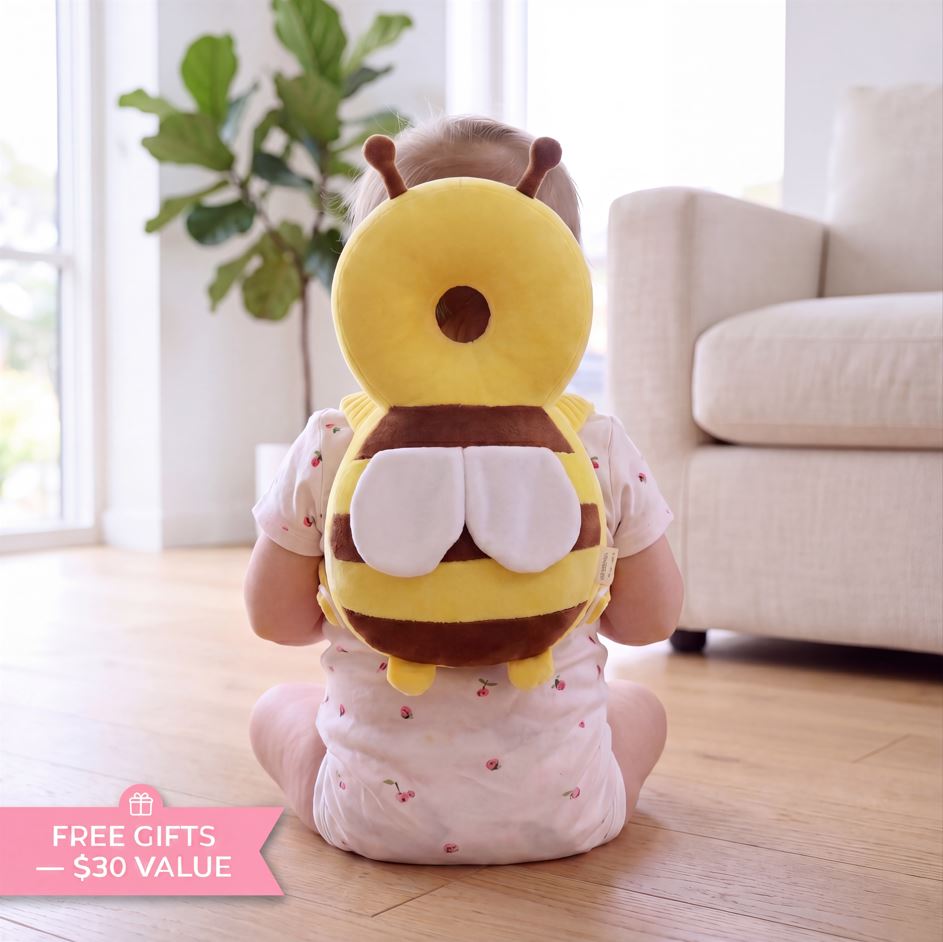
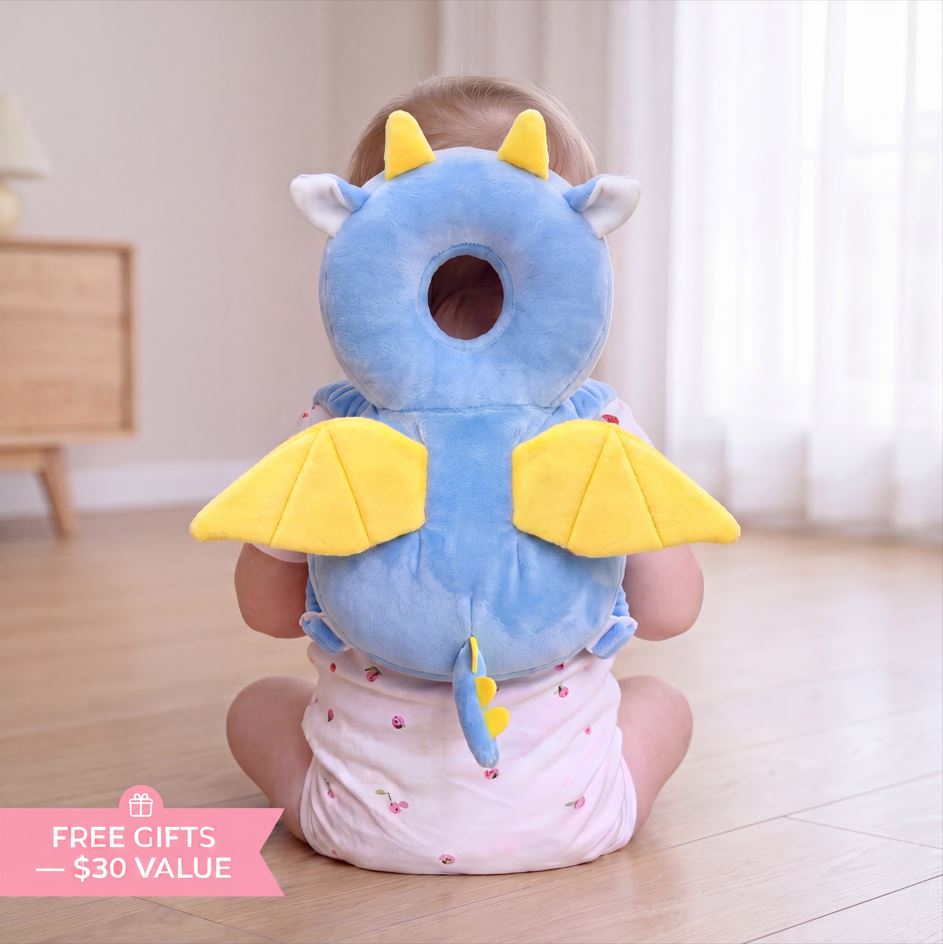
That's exactly what the BabyGuard solves — and it's not an accident. It doesn't look like safety gear. It looks like a stuffed animal Lila happens to be wearing. The turtle has a plush green hexagonal shell with little brown spikes and a soft white head cushion. The butterfly has soft purple wings and pink antennae that bounce when she moves. Boutique, not medical supply store.
Strangers at the park don't stare anymore — they stop us to ask where I got the turtle. My mother-in-law, who used to call me overprotective, asked where I bought it because her grandniece is starting to cruise.
But here's the part most parents miss until they've tried a helmet first: the cuteness isn't decoration. It's the most important safety feature on the product.
Because no protection works if your baby won't wear it. Lila treats her turtle the way other kids treat a favorite blanket. She brings it to me when she wants it on. She protests when I take it off for bath time. A backpack worn 8 hours a day beats a helmet worn 20 minutes a day every single time — against a force that never takes a break. That's not marketing. That's just math.
The First Test (And The Sound I Didn't Hear)
When the BabyGuard arrived, I put the turtle on Lila and braced myself. The first time she tipped backward wearing it, I closed my eyes and waited for the thud.
It never came.
Lila looked confused for half a second, pushed herself back up, and went right back to climbing the coffee table.
That night, I slept through for the first time in three months.
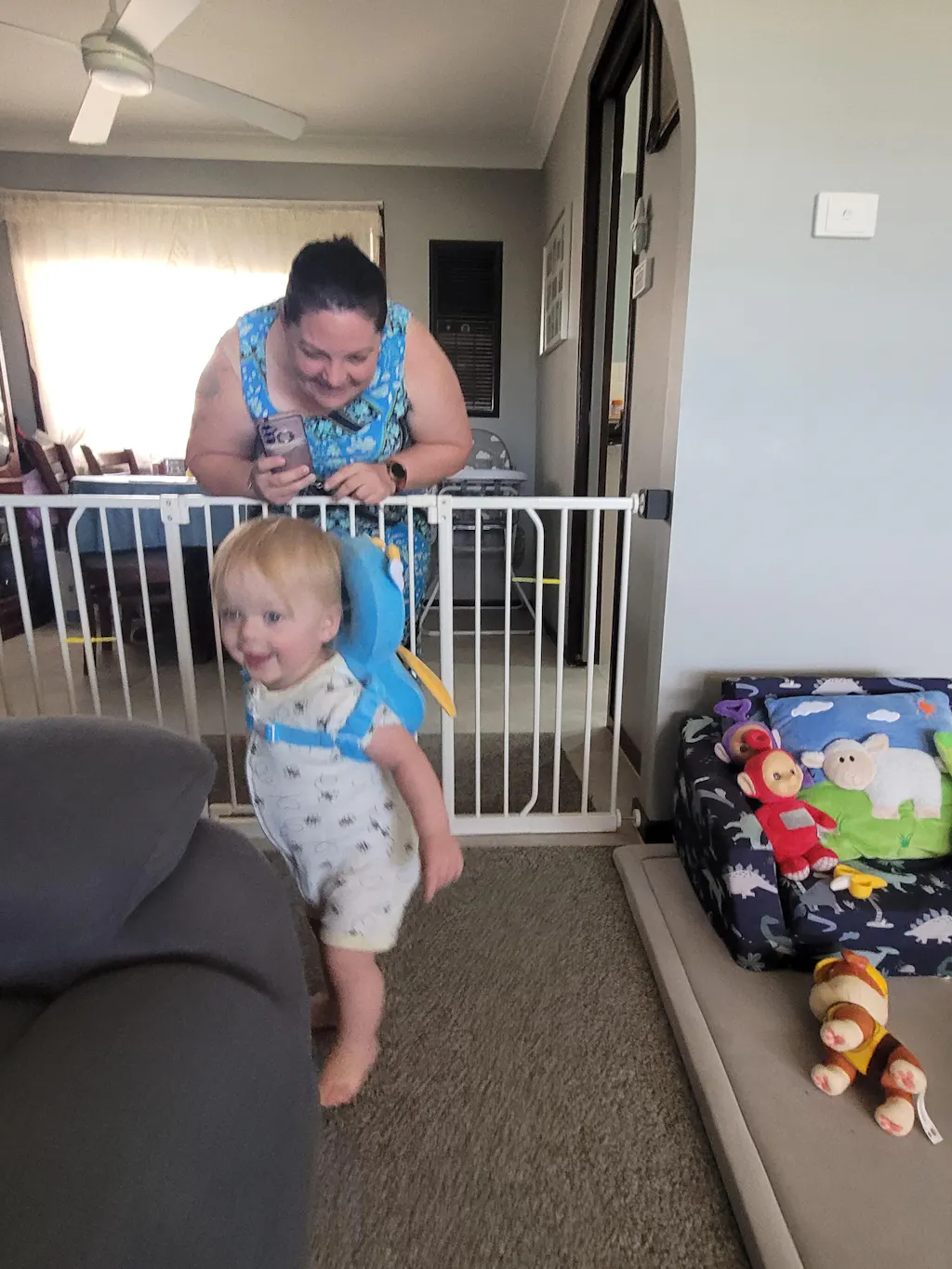
It's been 4 months. She's fallen backward more times than I can count — hardwood, tile, concrete at the park, grandma's linoleum. Gravity is still pulling on her exactly as hard as it always was. The difference is that now, when it wins, there's already something in place where it lands her. Not one thud. Not one 3 AM Google spiral. Not one panicked call to a triage nurse. And I finally stopped narrating every step she takes across the kitchen — I just let her go and watch her explore, the way I'd wanted to all along.
The turtle is now her favorite stuffed animal — she'd wear it to bed if I let her.
What Makes BabyGuard Different From The $12 Knockoffs
After months of stressful research, here's what makes BabyGuard different:
High-density PP cotton fill that doesn't flatten after the first wash, positioned exactly where the back of the head lands in a backward fall.
Soft crystal velvet surface babies actually want to touch — not the scratchy nylon on cheaper copies.
Reinforced chest strap that keeps the pack from shifting during a fall, gentle enough not to chafe.
Adjustable shoulder straps fitting 4 months through 24 months — the entire fall-prone window.
Just 7 ounces — about the weight of a small banana. Light enough that babies don't fight it the way they fight helmets.
Machine washable for spit-up, drool, and diaper disasters.
Animal designs (turtle, butterfly, dragon, astronaut, bee) babies actually get attached to — the only way head protection ever works.
Where Can I Get BabyGuard?
If you want to protect your baby's head from the backward falls she physically can't catch herself from — without putting her in a clinical-looking helmet — you need to act quickly.
Right now, every reader from this page can get 15% OFF their first BabyGuard plus FREE shipping.
But here's the catch: because the turtle and butterfly designs are the most popular, they sell out every few weeks. If you leave this page, you may end up on a 6-to-8 week waitlist — and gravity doesn't wait 6 to 8 weeks.
CHECK AVAILABILITY ↓
Covered By A 30-Day Money-Back Guarantee
The makers of BabyGuard are so confident that they offer a complete money-back guarantee. If your baby refuses to wear it, send it back. No questions asked. Based on the thousands of reviews I read, most babies are attached to it within a week — but you have a full 30 days to decide. It's the only baby head protector I found that's backed by a brand that actually understands what separates a product babies wear from one they fight.
How Much Longer Will You Leave It Up To Gravity?
Here's what doesn't change between now and the day your baby's backward reflex finally matures:
Gravity is pulling on a head that's nearly 20% of her body weight, every hour she's upright.
She faces hundreds of backward falls across the cruising and early-walking stage.
Her protective reflex won't be fully there until well into her second year.
Every one of those days, the floor stays exactly as hard as it is today, and you stay exactly as unable to cross a room faster than she can tip backward.
The BabyGuard isn't a helmet and it isn't a medical device. The manufacturer is upfront that it only protects the back of the head and back of the body — not the front or sides. But for the most common, and most frightening, direction gravity sends a cruising baby, it gives you the one thing foam mats and bumpers never could: protection that follows your baby into every room — and that she actually wants to wear.
You can keep hovering. Keep buying foam mats. Keep listening for that thud. Or you can put the one piece of protection that's already in place the next time gravity does what gravity does.
The choice is yours. But please — don't wait for your Saturday afternoon.